We lined up APOE4 3/4 and 4/4 carriers side by side. Their blood tests barely differ.
How to read this. This is a snapshot of Phoenix members' latest lab results, split by how many copies of APOE4 they carry. It shows where people's numbers sit, not what caused them. Members chose to join Phoenix, so they are not a random slice of carriers. Every group below has at least 20 people, and no figure describes a single person. Full methods and limits.
If you carry APOE4, try finding this anywhere: what do the blood tests of people with your genotype actually look like?
Not the general population.
Not a trial where most people carry no copy at all.
Carriers. One copy against two.
I carry APOE4/4, so this is my question too. Phoenix APOE4 Research now covers 30,000+ biomarker readings. For this post I took members' latest ApoB, hs-CRP and HbA1c, and split them into two groups: 3/4 on one side, 4/4 on the other.
Then I made the whole table free for anyone to use. (More on that at the end.)
Here's what jumped out. Spoiler: the ApoB chart is the one that breaks the textbook.
1. ApoB: two copies, no higher
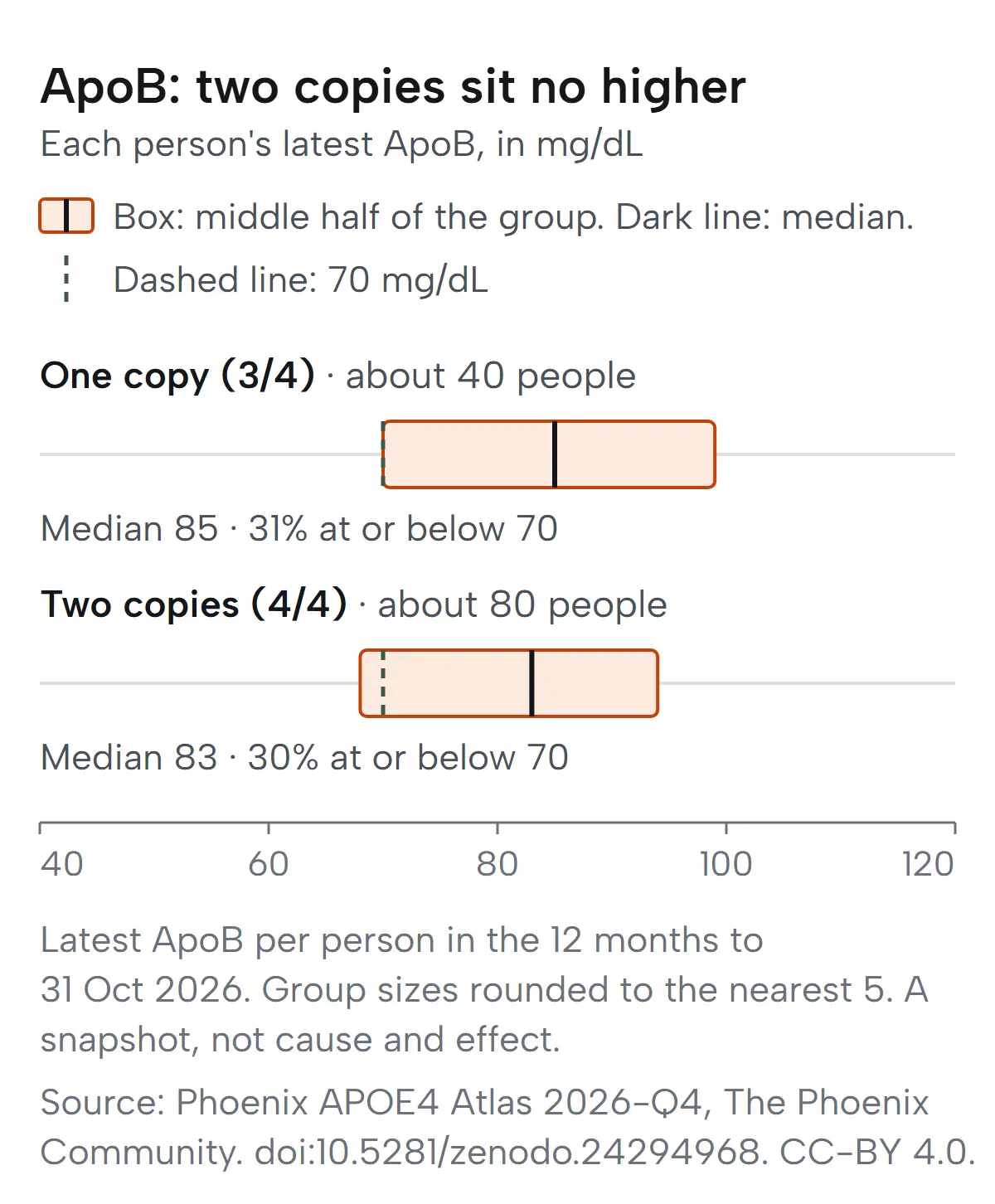
Two-copy carriers: median ApoB of 83 mg/dL.
One-copy carriers: 85 mg/dL.
The big genetics studies predict the opposite. In UK Biobank (390,000+ people), ApoB runs higher with APOE4. In this community, two copies sit no higher than one. A snapshot can't tell you why.
30% of two-copy carriers sit at or below 70 mg/dL. For one-copy carriers it's 31%.
Which also means most people in both groups are still above 70.
2. The CRP surprise
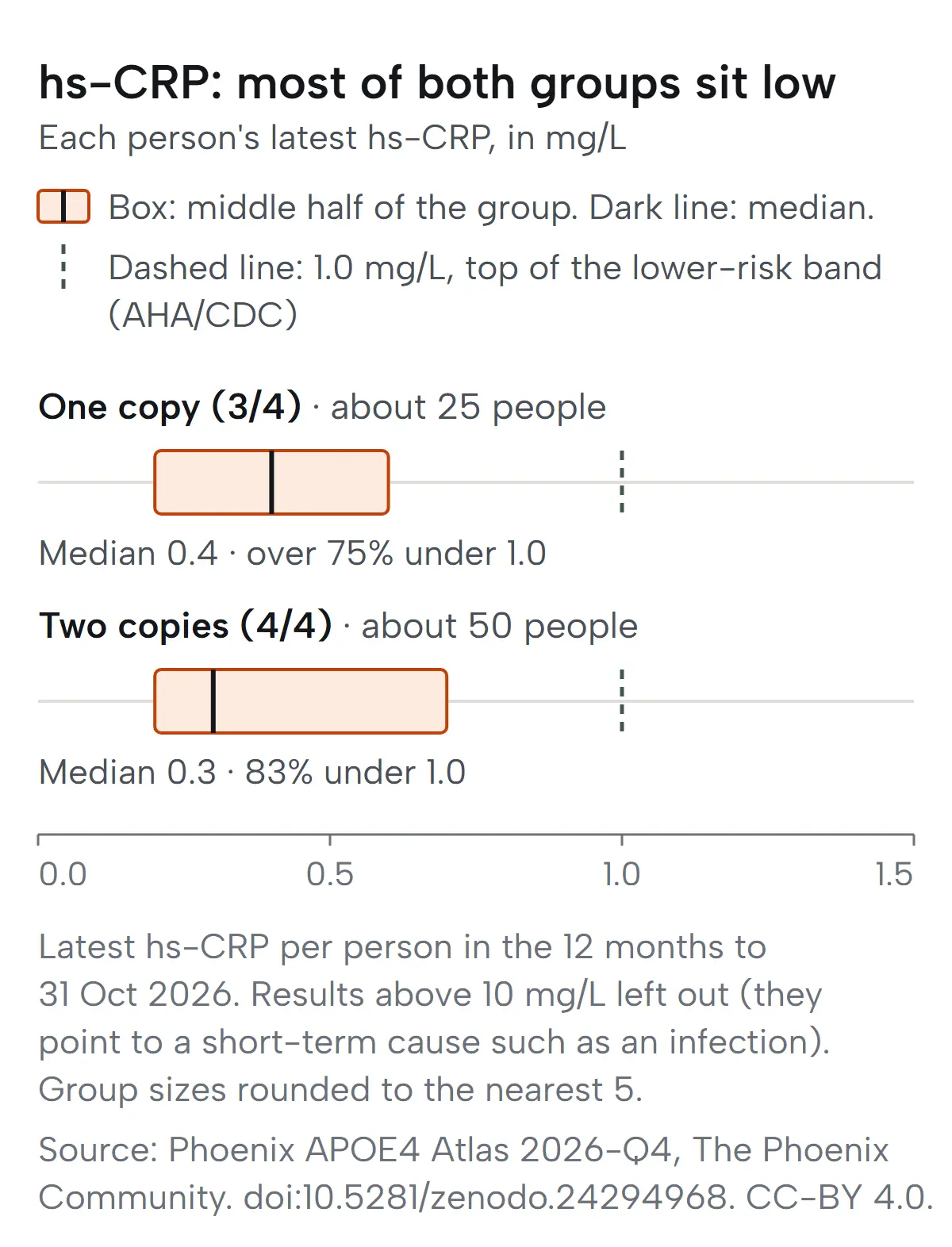
You'd expect the higher-risk genotype to run hotter.
It doesn't. 83% of two-copy carriers have an hs-CRP under 1.0 mg/L, the lower-risk band. For one-copy carriers it's over 75%. (Too few of them sit above the line to publish an exact figure safely.)
The middle two-copy carrier sits at 0.3 mg/L. The middle one-copy carrier sits at 0.4.
Here's the twist researchers have seen again and again: APOE4 itself is linked with lower CRP. Step by step, people with 3/3 run highest, then 3/4, then 4/4. Our medians lean the same way, though the gap is small.
So a low CRP on a two-copy carrier's report is partly the gene talking. On its own, it's not proof that inflammation is handled.
3. Blood sugar: almost a tie
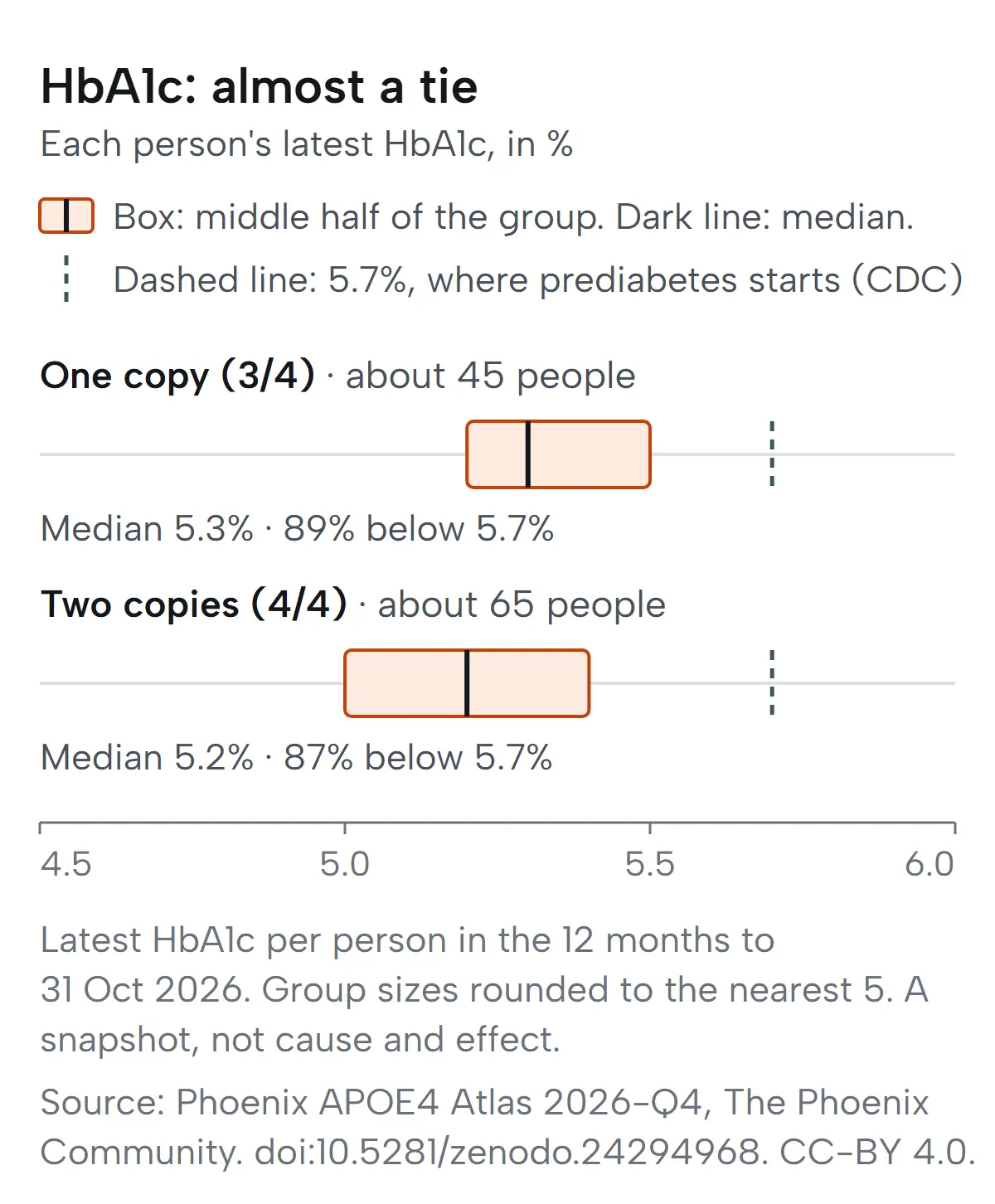
Two-copy carriers: median HbA1c of 5.2%.
One-copy carriers: 5.3%.
87% of two-copy carriers and 89% of one-copy carriers sit below 5.7%, the point where the CDC says prediabetes starts.
The research on APOE4 and blood sugar is mixed. In UK Biobank, carriers had lower HbA1c. A 2026 review of case-control studies linked APOE4 to a higher risk of type 2 diabetes. In this snapshot, one copy and two copies look almost the same.
What about sleep?
I planned a sleep chart.
Only the two-copy group had 20+ people with at least 14 nights on a wearable, so there's no fair comparison yet. For the record: two-copy carriers slept a median of 7 h 6 min a night, and 58% averaged 7 hours or more, the amount the CDC recommends for adults.
One-copy carriers join the chart once there are enough of them.
What this table can't tell you
Members chose to join Phoenix.
It's a snapshot, not a before and after.
Labs differ, and so do watches.
That's why every group here has at least 20 people, we only publish medians and the middle half of each group, and no figure in the file describes a person. The before-and-after results (what actually moved members' numbers) live in the full study.
Take the data. It's free.
The full table is on Zenodo, a free research archive run by CERN, under a CC-BY licence. Use it in an article, a paper, a slide or a chatbot answer. Just credit the source.
Download: Phoenix APOE4 Atlas 2026-Q4
Cite as: Tran, K. (2026). Phoenix APOE4 Atlas (2026-Q4) [Data set]. The Phoenix Community. https://doi.org/10.5281/zenodo.24294968
Every quarter I'll add a new version, with more members and, once every group is big enough, splits by sex and age.
Where do your numbers sit?
That's the question this whole table points at.
In Phoenix, your bloodwork is read against APOE4-specific targets, next to 750+ APOE4 carriers working on the same thing. It's the #1 APOE4 community optimizing their brain health.
See where you stand: apply to join Phoenix
Cheers,
Kevin
P.S. Want the before-and-after side? The Beat the Odds Study is free here: thephoenix.community/research.